
Red, Yellow, Green: The Goal Pyramid That Keeps a Whole Business Aligned
Every team is busy, but is the work actually moving the business toward its goals? A goal pyramid turns that question into something you can see at a glance, in red, yellow, and green. Here's how it works and why it works.

Ask almost any business owner if their team is busy and the answer is yes. Ask whether all that motion is actually moving the company toward its goals, and the room gets quiet. Not because nobody cares, because nobody can see it. Effort is easy to measure. Progress is not.
That gap is where good companies quietly drift. Everyone works hard, every week looks full, and a year later the business is in roughly the same place it started. The work was real. It just wasn’t pointed at anything.
We built a tool to fix that for ourselves, a structure we call a goal pyramid, and the idea behind it is simple enough that any business can use it. Here’s how it works, and why it works.
What a goal pyramid actually is
Picture your company as a pyramid.
At the very top sits the small handful of things that actually define success, your real goals. Not forty of them. The three, four, maybe six outcomes the business is genuinely trying to achieve: grow profitably, keep clients for life, protect the business, whatever yours truly are. Keep the list short on purpose; if everything is a goal, nothing is.
Below the apex, the pyramid widens into the major areas those goals depend on, how you deliver service, how you run operations, how you manage money, how you keep things secure, how you grow. And below those, it widens again into the specific, concrete blocks of work that make each area run, ownable things like “every recurring task has a written procedure” or “backups are verified, not just scheduled”, each with one name attached: a person, or increasingly an AI worker, accountable for it.
The base is the widest part for a reason: the blocks at the bottom are the foundational ones everything above depends on. A flashy initiative three tiers up is worth nothing if the foundation beneath it is cracked. And the rule that makes it a pyramid instead of a to-do list is this: every block has to ladder up. Work that doesn’t support an area, and an area that doesn’t support a goal, doesn’t belong on the pyramid. The moment you arrange a business this way, the busywork that serves no goal has nowhere left to hide.
Scoring where you actually are
A pyramid of boxes is just an org chart until you put a number on each block. So every block gets a simple maturity score, 1 to 5:
- 1, we wing it. No real process; it works because one specific person makes it work.
- 3, it’s standardized. There’s a documented way we do this, and we mostly follow it.
- 5, it’s best-in-class. It runs itself, improves itself, and rarely surprises us.
Then comes the part most goal-setting skips. Each block also gets a target, where it needs to be, and a date to get there. “Our intake process is a 2 today; it needs to be a 4 by next spring.” Now a vague aspiration (“get better at intake”) is a measurable gap with a deadline.
This is deliberately honest. You don’t get to set every block to 5 and feel good about it, a wall of red that says “we’re failing at everything” just demoralizes people. You pick the two or three blocks that matter most right now and push those, while the rest hold steady.
Red, yellow, green
Here’s the layer you actually look at every day.
Every block on the pyramid carries one of three colors:
- Green, on track. At or above where it needs to be, or climbing fast enough to get there on time.
- Yellow, slipping. Still moving, but too slowly to hit the target by the deadline.
- Red, needs attention now. Going backward, or a hard limit has been crossed.
The colors aren’t decoration. They’re a triage system for the whole company, and they obey one rule that makes them trustworthy: a parent is only as healthy as its weakest child. A single red block at the bottom turns its entire branch red, all the way to the top. A tier doesn’t get to show green because most of its blocks are fine, same logic as a chain being only as strong as its weakest link, made visible at every level. You can’t bury a weak spot under a tidy summary, because the weak spot colors everything above it.
That’s the power of the glance. A leader looks at the top, sees a goal slipping into yellow, and follows the color down through the tiers to the one red block at the base that’s dragging everything above it. Drift stops being something you discover in a quarterly post-mortem and becomes something you see the week it starts.
A live data source behind every block
Here’s what makes the pyramid an instrument instead of a survey: nobody colors the blocks by hand.
Every block is wired to a real, live data source, the actual system where that work already leaves a trail. “Backups are verified” reads from your backup monitor. “MFA everywhere” reads from your identity provider. “Response time” reads from your ticketing system. “Margin on track” reads from your accounting. The block isn’t someone’s opinion of how things are going; it’s plugged into the place that already knows.
And the scoring runs every day, automatically. A local AI, running on hardware we own, so your operational data never leaves the building, reads each block’s data source, compares what’s actually true against the target, and sets the color. Green, yellow, red, recomputed daily against live reality. When three admin accounts slip past their review window, the access-review block goes red the next morning on its own, not whenever someone finally remembers to update a spreadsheet.
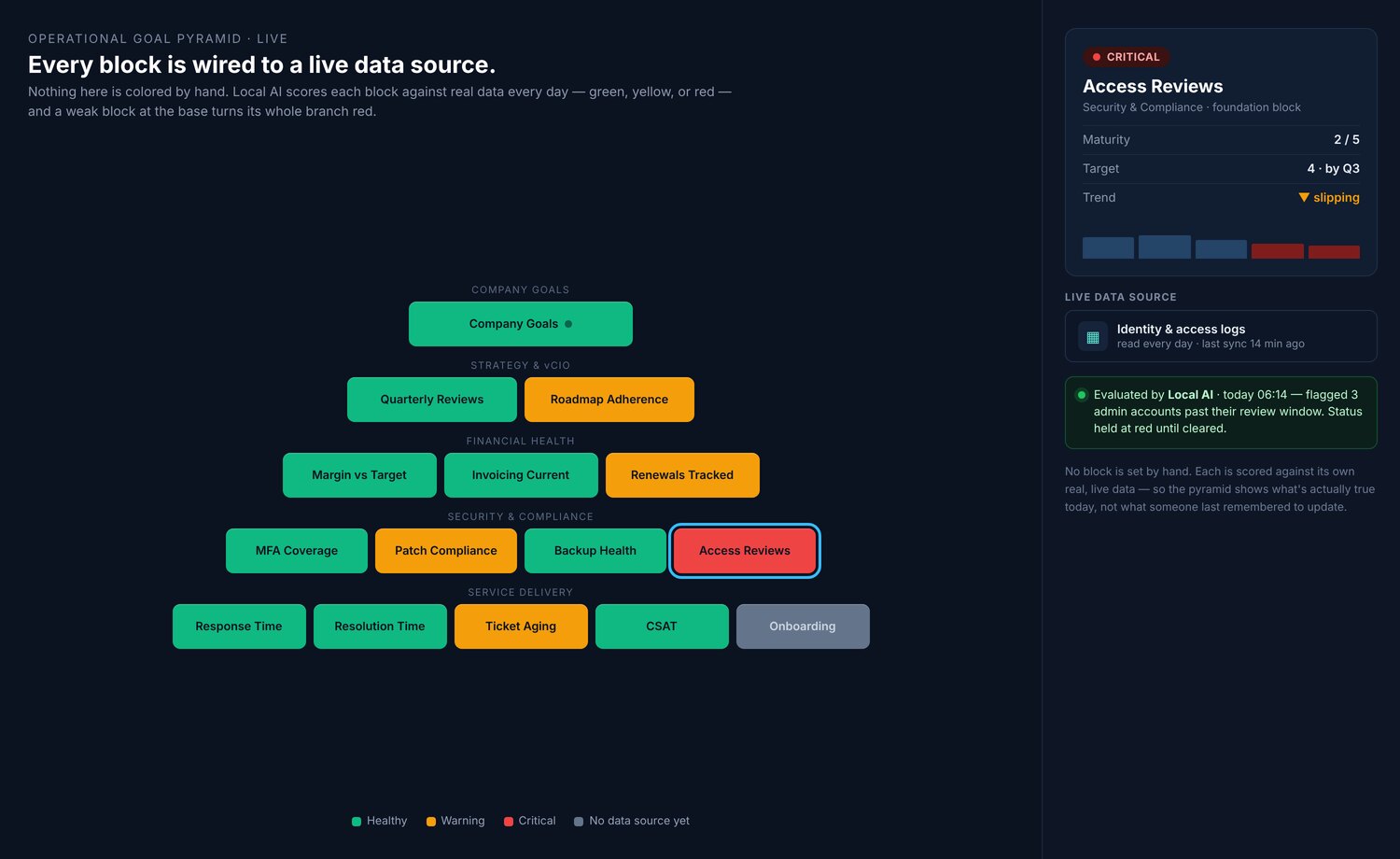
This is the difference between a dashboard and a heartbeat. A quarterly maturity survey is a snapshot of what people believed was true on the day they filled it out, already stale by the time it’s presented. A pyramid fed by live data and scored daily by AI tells you what’s true today; the block that quietly went red last Tuesday is already flashing, because the data said so before any human noticed.
It also means the work and the measurement share the same nervous system. The same AI virtual employees that work the gaps, closing the distance from red to green, read from and report to the very same pyramid. They don’t just do tasks; they do tasks aimed at the blocks that are slipping, and the next morning’s score tells everyone, human and AI alike, whether it worked.
What the colors change
When every task is visibly tied to a goal, and its health is right there in color, two things happen on their own.
Busywork gets exposed. Plenty of work in any organization is genuinely orphaned: a report nobody reads, a meeting that exists because it always has, a process that solved a problem which went away two years ago. As long as that work is invisible, it survives forever. The moment you try to draw a line from it up to a goal and can’t, you’ve found something to stop doing. The pyramid doesn’t just show you what to work on, it gives you evidence to stop working on what serves no goal.
Priorities settle arguments. When two urgent things collide, “which one ladders up to a more foundational goal?” is a far better tiebreaker than “who asked loudest.” The structure makes the trade-off legible to everyone, so the team spends its energy on the work instead of litigating whose work matters more.
”Are we green, or just green today?”
A color tells you where you are. It doesn’t tell you where you’re headed, and that’s where most dashboards quietly lie.
A block can be green today and still be a problem, because it’s stopped improving and the deadline is coming. So the pyramid doesn’t only score the present; it watches the trajectory. It looks at your history, measures how fast a block is actually improving, and compares that to how fast it needs to improve to hit the target on time.
The result is an honest verdict, ahead, on track, stagnating, or going backward, plus a projected date you’ll actually arrive if nothing changes. A block that’s red today but climbing toward its target is fine; it’s on plan. A block that’s green today but quietly sliding is the one to watch. Health plus trajectory beats a static snapshot every time, and it warns you about the future instead of just reporting the past.
It also keeps targets grounded. Real organizations improve any one area by about a single maturity level every twelve to eighteen months. Ask the pyramid to take a block from a 2 to a 5 by next quarter and it tells you the required pace is fantasy, then asks what your actual plan is. Honesty in, honesty out.
Turning gaps into work, this is where the AI comes in
A pyramid that only measures is a very sophisticated way to feel bad. The point isn’t the scoreboard; it’s what the scoreboard tells you to do.
So the system closes the loop. Each block’s gap, the distance between where it is and where it needs to be, becomes concrete work: the specific tasks that would move it from red toward green. Instead of a quarterly panic about goals nobody looked at, there’s a steady stream of the right next actions, generated from the goals themselves.
This is exactly where an AI workforce earns its place, and where alignment stops being a soft management nicety and becomes a hard requirement. A human doing pointless work eventually gets bored and drifts off it. An AI worker will do pointless work perfectly, forever, and never complain. So as you hand routine, high-volume tasks to AI virtual employees, the danger isn’t that they do too little, it’s that they work tirelessly, at scale, on the wrong thing.
A goal pyramid is the structure that prevents exactly that. We run a team of AI virtual employees, we call it the Dog Pack, and the pyramid is what keeps that team pointed at the right things. Give every AI worker an owned block, tie that block to a goal at the apex, and the AI is accountable to the company’s goals rather than just to its own task. Humans stay in control of what the goals are and whether the work still serves them; the structure makes sure every hour of effort, human or AI, lands where it’s supposed to.
The quarterly ritual that keeps it honest
The day-to-day colors are the awareness layer. The load-bearing habit is the quarterly review, the same discipline a good company applies to its clients, finally turned on itself.
Once a quarter, the pyramid snapshots every block: what improved, what stalled, what went backward, what got finished. Where a target is clearly going to be missed, the system lays out the honest options, extend the date, lower the target, or add the work to close the gap, and a human makes the call. Every target change is logged with a reason, so goals can be revised but never quietly abandoned. A target that always slips isn’t a target; it’s a wish.
This is the part that turns strategy from a slide deck someone built in January into a living thing the business actually steers by all year.
Why it works
Strip it down and a goal pyramid works for four plain reasons:
- It makes progress visible. Effort was always easy to see; now progress is too. You manage what you can see.
- It forces alignment. Work that doesn’t ladder up to a goal stands out, and gets cut. Everyone’s effort points the same direction.
- It’s honest about pace. Knowing where you are means little without knowing whether you’re moving fast enough. The pyramid tells you both, early.
- It creates accountability without a witch hunt. Red isn’t blame, it’s a flashlight. It points at the work, not the person, and tells you exactly where the next hour should go.
The businesses that get measurably, deliberately better are the ones that pull away from the pack. Maturity isn’t vanity, it’s resilience, and it’s profit. A company that can see itself clearly makes better decisions than one running on gut feel and a full calendar. That discipline, capable automation kept rigorously aligned to a few clear goals, with humans owning the direction, is at the heart of what it means to operate as a Managed Intelligence Provider instead of just another IT vendor.
The honest version
We didn’t build this because it sounded impressive. We built it because we were tired of being busy without being sure we were getting better, and we’d rather solve a problem for ourselves before we recommend it to anyone else.
You don’t need our software to start. Write down your real goals, the short list. Under each, name the few areas of work that support it. Under those, list the blocks and put one owner’s name on each. Then ask the uncomfortable question of every recurring activity in the business: which block does this serve, and which goal does that block ladder up to? The work with no answer is your first win. Add a simple red-yellow-green signal per block, roll the worst one up to the top, and the drawing becomes a living instrument, one that tells you at a glance whether your business is actually moving toward the handful of things you said mattered most.
Want help mapping your business to its real goals, and finding the busywork to retire? Start with a business IT assessment and we’ll look at how your team’s work connects to your goals today, and where intelligent automation could carry more of the load without drifting off course.
Red, Yellow, Green: The Goal Pyramid That Keeps a Whole Business Aligned
Every team is busy, but is the work actually moving the business toward its goals? A goal pyramid turns that question into something you can see at a glance, in red, yellow, and green. Here's how it works and why it works.
Ask almost any business owner if their team is busy and the answer is yes. Ask whether all that motion is actually moving the company toward its goals, and the room gets quiet. Not because nobody cares, because nobody can see it. Effort is easy to measure. Progress is not.
That gap is where good companies quietly drift. Everyone works hard, every week looks full, and a year later the business is in roughly the same place it started. The work was real. It just wasn’t pointed at anything.
We built a tool to fix that for ourselves, a structure we call a goal pyramid, and the idea behind it is simple enough that any business can use it. Here’s how it works, and why it works.
What a goal pyramid actually is
Picture your company as a pyramid.
At the very top sits the small handful of things that actually define success, your real goals. Not forty of them. The three, four, maybe six outcomes the business is genuinely trying to achieve: grow profitably, keep clients for life, protect the business, whatever yours truly are. Keep the list short on purpose; if everything is a goal, nothing is.
Below the apex, the pyramid widens into the major areas those goals depend on, how you deliver service, how you run operations, how you manage money, how you keep things secure, how you grow. And below those, it widens again into the specific, concrete blocks of work that make each area run, ownable things like “every recurring task has a written procedure” or “backups are verified, not just scheduled”, each with one name attached: a person, or increasingly an AI worker, accountable for it.
The base is the widest part for a reason: the blocks at the bottom are the foundational ones everything above depends on. A flashy initiative three tiers up is worth nothing if the foundation beneath it is cracked. And the rule that makes it a pyramid instead of a to-do list is this: every block has to ladder up. Work that doesn’t support an area, and an area that doesn’t support a goal, doesn’t belong on the pyramid. The moment you arrange a business this way, the busywork that serves no goal has nowhere left to hide.
Scoring where you actually are
A pyramid of boxes is just an org chart until you put a number on each block. So every block gets a simple maturity score, 1 to 5:
- 1, we wing it. No real process; it works because one specific person makes it work.
- 3, it’s standardized. There’s a documented way we do this, and we mostly follow it.
- 5, it’s best-in-class. It runs itself, improves itself, and rarely surprises us.
Then comes the part most goal-setting skips. Each block also gets a target, where it needs to be, and a date to get there. “Our intake process is a 2 today; it needs to be a 4 by next spring.” Now a vague aspiration (“get better at intake”) is a measurable gap with a deadline.
This is deliberately honest. You don’t get to set every block to 5 and feel good about it, a wall of red that says “we’re failing at everything” just demoralizes people. You pick the two or three blocks that matter most right now and push those, while the rest hold steady.
Red, yellow, green
Here’s the layer you actually look at every day.
Every block on the pyramid carries one of three colors:
- Green, on track. At or above where it needs to be, or climbing fast enough to get there on time.
- Yellow, slipping. Still moving, but too slowly to hit the target by the deadline.
- Red, needs attention now. Going backward, or a hard limit has been crossed.
The colors aren’t decoration. They’re a triage system for the whole company, and they obey one rule that makes them trustworthy: a parent is only as healthy as its weakest child. A single red block at the bottom turns its entire branch red, all the way to the top. A tier doesn’t get to show green because most of its blocks are fine, same logic as a chain being only as strong as its weakest link, made visible at every level. You can’t bury a weak spot under a tidy summary, because the weak spot colors everything above it.
That’s the power of the glance. A leader looks at the top, sees a goal slipping into yellow, and follows the color down through the tiers to the one red block at the base that’s dragging everything above it. Drift stops being something you discover in a quarterly post-mortem and becomes something you see the week it starts.
A live data source behind every block
Here’s what makes the pyramid an instrument instead of a survey: nobody colors the blocks by hand.
Every block is wired to a real, live data source, the actual system where that work already leaves a trail. “Backups are verified” reads from your backup monitor. “MFA everywhere” reads from your identity provider. “Response time” reads from your ticketing system. “Margin on track” reads from your accounting. The block isn’t someone’s opinion of how things are going; it’s plugged into the place that already knows.
And the scoring runs every day, automatically. A local AI, running on hardware we own, so your operational data never leaves the building, reads each block’s data source, compares what’s actually true against the target, and sets the color. Green, yellow, red, recomputed daily against live reality. When three admin accounts slip past their review window, the access-review block goes red the next morning on its own, not whenever someone finally remembers to update a spreadsheet.
This is the difference between a dashboard and a heartbeat. A quarterly maturity survey is a snapshot of what people believed was true on the day they filled it out, already stale by the time it’s presented. A pyramid fed by live data and scored daily by AI tells you what’s true today; the block that quietly went red last Tuesday is already flashing, because the data said so before any human noticed.
It also means the work and the measurement share the same nervous system. The same AI virtual employees that work the gaps, closing the distance from red to green, read from and report to the very same pyramid. They don’t just do tasks; they do tasks aimed at the blocks that are slipping, and the next morning’s score tells everyone, human and AI alike, whether it worked.
What the colors change
When every task is visibly tied to a goal, and its health is right there in color, two things happen on their own.
Busywork gets exposed. Plenty of work in any organization is genuinely orphaned: a report nobody reads, a meeting that exists because it always has, a process that solved a problem which went away two years ago. As long as that work is invisible, it survives forever. The moment you try to draw a line from it up to a goal and can’t, you’ve found something to stop doing. The pyramid doesn’t just show you what to work on, it gives you evidence to stop working on what serves no goal.
Priorities settle arguments. When two urgent things collide, “which one ladders up to a more foundational goal?” is a far better tiebreaker than “who asked loudest.” The structure makes the trade-off legible to everyone, so the team spends its energy on the work instead of litigating whose work matters more.
”Are we green, or just green today?”
A color tells you where you are. It doesn’t tell you where you’re headed, and that’s where most dashboards quietly lie.
A block can be green today and still be a problem, because it’s stopped improving and the deadline is coming. So the pyramid doesn’t only score the present; it watches the trajectory. It looks at your history, measures how fast a block is actually improving, and compares that to how fast it needs to improve to hit the target on time.
The result is an honest verdict, ahead, on track, stagnating, or going backward, plus a projected date you’ll actually arrive if nothing changes. A block that’s red today but climbing toward its target is fine; it’s on plan. A block that’s green today but quietly sliding is the one to watch. Health plus trajectory beats a static snapshot every time, and it warns you about the future instead of just reporting the past.
It also keeps targets grounded. Real organizations improve any one area by about a single maturity level every twelve to eighteen months. Ask the pyramid to take a block from a 2 to a 5 by next quarter and it tells you the required pace is fantasy, then asks what your actual plan is. Honesty in, honesty out.
Turning gaps into work, this is where the AI comes in
A pyramid that only measures is a very sophisticated way to feel bad. The point isn’t the scoreboard; it’s what the scoreboard tells you to do.
So the system closes the loop. Each block’s gap, the distance between where it is and where it needs to be, becomes concrete work: the specific tasks that would move it from red toward green. Instead of a quarterly panic about goals nobody looked at, there’s a steady stream of the right next actions, generated from the goals themselves.
This is exactly where an AI workforce earns its place, and where alignment stops being a soft management nicety and becomes a hard requirement. A human doing pointless work eventually gets bored and drifts off it. An AI worker will do pointless work perfectly, forever, and never complain. So as you hand routine, high-volume tasks to AI virtual employees, the danger isn’t that they do too little, it’s that they work tirelessly, at scale, on the wrong thing.
A goal pyramid is the structure that prevents exactly that. We run a team of AI virtual employees, we call it the Dog Pack, and the pyramid is what keeps that team pointed at the right things. Give every AI worker an owned block, tie that block to a goal at the apex, and the AI is accountable to the company’s goals rather than just to its own task. Humans stay in control of what the goals are and whether the work still serves them; the structure makes sure every hour of effort, human or AI, lands where it’s supposed to.
The quarterly ritual that keeps it honest
The day-to-day colors are the awareness layer. The load-bearing habit is the quarterly review, the same discipline a good company applies to its clients, finally turned on itself.
Once a quarter, the pyramid snapshots every block: what improved, what stalled, what went backward, what got finished. Where a target is clearly going to be missed, the system lays out the honest options, extend the date, lower the target, or add the work to close the gap, and a human makes the call. Every target change is logged with a reason, so goals can be revised but never quietly abandoned. A target that always slips isn’t a target; it’s a wish.
This is the part that turns strategy from a slide deck someone built in January into a living thing the business actually steers by all year.
Why it works
Strip it down and a goal pyramid works for four plain reasons:
- It makes progress visible. Effort was always easy to see; now progress is too. You manage what you can see.
- It forces alignment. Work that doesn’t ladder up to a goal stands out, and gets cut. Everyone’s effort points the same direction.
- It’s honest about pace. Knowing where you are means little without knowing whether you’re moving fast enough. The pyramid tells you both, early.
- It creates accountability without a witch hunt. Red isn’t blame, it’s a flashlight. It points at the work, not the person, and tells you exactly where the next hour should go.
The businesses that get measurably, deliberately better are the ones that pull away from the pack. Maturity isn’t vanity, it’s resilience, and it’s profit. A company that can see itself clearly makes better decisions than one running on gut feel and a full calendar. That discipline, capable automation kept rigorously aligned to a few clear goals, with humans owning the direction, is at the heart of what it means to operate as a Managed Intelligence Provider instead of just another IT vendor.
The honest version
We didn’t build this because it sounded impressive. We built it because we were tired of being busy without being sure we were getting better, and we’d rather solve a problem for ourselves before we recommend it to anyone else.
You don’t need our software to start. Write down your real goals, the short list. Under each, name the few areas of work that support it. Under those, list the blocks and put one owner’s name on each. Then ask the uncomfortable question of every recurring activity in the business: which block does this serve, and which goal does that block ladder up to? The work with no answer is your first win. Add a simple red-yellow-green signal per block, roll the worst one up to the top, and the drawing becomes a living instrument, one that tells you at a glance whether your business is actually moving toward the handful of things you said mattered most.
Want help mapping your business to its real goals, and finding the busywork to retire? Start with a business IT assessment and we’ll look at how your team’s work connects to your goals today, and where intelligent automation could carry more of the load without drifting off course.