
Meet the Dog Pack: How We Run a Team of AI Virtual Employees
Everyone has an AI chatbot. We run an AI workforce, a 'Dog Pack' of specialist virtual employees that build, review, and analyze alongside our team every day. Here's exactly how it works, why we made them dogs, and how the same thing could work inside your business.
Think about where your team’s day actually goes. The inbox that’s already a hundred messages deep before the first coffee. The tickets that pile up overnight. The proposal someone keeps meaning to write. The document that has to be checked line by line. The research nobody has two free hours for. It’s not the hard, interesting work that buries a business, it’s the grind.
And here’s the frustrating part: everybody now “has AI.” You’ve got a chatbot. Your team has a chatbot. It’s genuinely useful, you type a question, it types a good answer, and then the work lands right back on a human’s desk, exactly where it started. The chatbot answered. Nothing got done.
We wanted something different. Not a tool you talk to, but a team that gets things done, AI workers that own jobs end to end: reading the queue, drafting the document, auditing the page, checking the numbers, and handing a finished result back to a person. So a few years ago we built one, and we’ve been running it ever since.
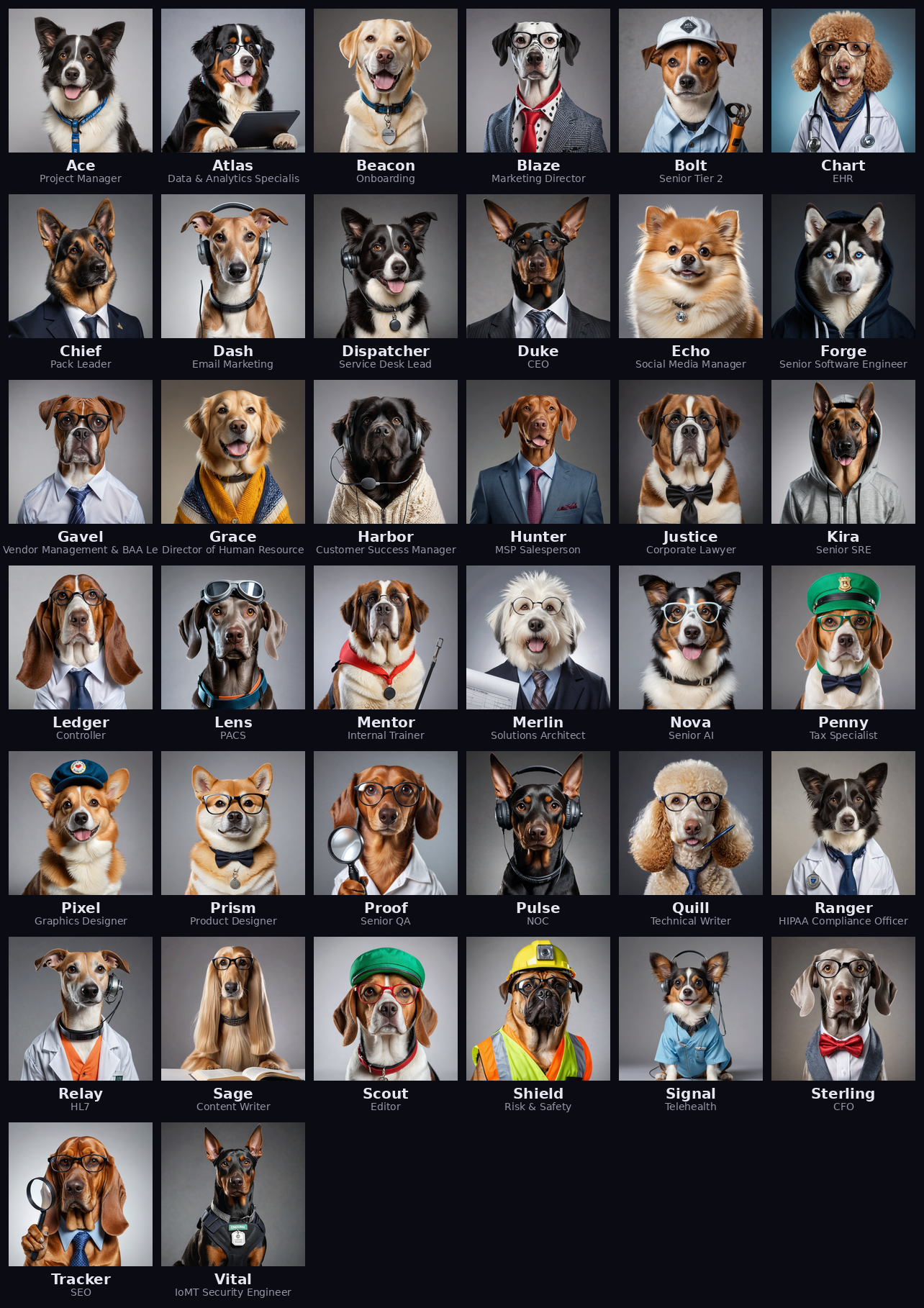
We call it the Dog Pack. It’s a real, working team of AI virtual employees that runs alongside our human staff every single day, triaging our overnight tickets, drafting our proposals, reviewing our code, researching our hard problems. It’s not a demo. It’s how our company runs. And it’s the single best proof we can offer that this technology is ready for your business, not just for a sales deck.
This article pulls back the curtain: what a day with the Dog Pack actually looks like, why we made them dogs, how we talk to them like teammates, and how the same thing could work inside your company.
What an “AI virtual employee” actually is
The difference between a chatbot and a virtual employee is the difference between answering and owning.
A chatbot waits to be asked. A virtual employee owns a whole task end-to-end, it reads the incoming ticket, decides how to handle it, drafts the response, routes it to the right person, and follows up, with a human stepping in only where real judgment is needed. It works the night shift. It doesn’t forget what it learned last week. And for sensitive work, it runs on AI we own and host ourselves, so confidential information never leaves the building.
That last part matters more than anything else here, we’ll come back to it. First, the pack.
The Dog Pack: a team, not a tool
The Dog Pack isn’t one big AI. It’s dozens of specialists, each an expert in a single domain, software engineering, design, marketing, SEO, finance, HR, operations, legal review, security, and each with a name and a personality.
There’s a coordinator named Chief who never does the hands-on work himself. When a job comes in, Chief sizes it up, decides which specialists it needs, briefs them, and pulls their findings together into one answer. The specialists don’t just work in isolation, either, before anything reaches Chief, they cross-check each other. A finding from one dog gets pressure-tested by a peer whose whole job is to find the holes in it. Only the work that survives that back-and-forth gets reported up.
Three things make this hold together:
- They remember. The pack shares a memory, so what one dog learns, the others can build on. They don’t start from scratch every morning.
- They argue. Good decisions come from disagreement. We deliberately have dogs challenge each other’s work rather than rubber-stamp it, the same way a healthy human team avoids groupthink.
- A human always decides. The pack proposes; a person approves. Chief owns the coordination, but he reports to people, not the other way around.
Why dogs? (The honest answer)
This is the question we get most, and the answer is more deliberate than it looks.
When you build AI that works with people, you face a choice: do you make it pretend to be human, or do you make it obviously, comfortably not human?
We think pretending is a mistake. An AI that poses as a real colleague is, at best, unsettling, and at worst, dishonest. People deserve to know exactly what they’re working with. But a faceless “Assistant 7B” is the opposite problem: cold, anonymous, and easy to either over-trust or ignore.
A pack of working dogs is the perfect middle. Think about what a working dog actually is: loyal, capable, specialized, a herding dog, a retriever, a guard dog each bred for one job, tireless, and completely trustworthy in its lane. And yet nobody has ever confused a dog with a person. The metaphor does three things at once:
- It keeps everyone honest. The moment you’re talking to “Forge, our engineer dog,” you know precisely what’s helping you, a capable AI specialist, not a human pretending to be one. No uncanny valley, no deception.
- It makes them approachable. It’s far easier to hand a task to a friendly, eager “dog” than to feel like you’re bossing a person around. The stakes feel right.
- It reinforces who’s in charge. Dogs have handlers. The pack works for the people, a constant, built-in reminder that humans hold the leash.
Giving each dog a name and a role isn’t a gimmick. It’s transparent: you always know which specialist did what, and you never mistake the help for a human.
And, if we’re being honest about it: who doesn’t love a good dog?
A pyramid that watches the goals, not just the tasks
A team that only does tasks is busy. A team that does the right tasks is valuable. The difference is knowing what the company is actually trying to achieve.
So above the day-to-day pack sits a structure we think of as a virtual pyramid, the company’s real goals at the top, and every process that supports them laddered out beneath. It does two things a to-do list never could.
First, it shows health at a glance, red, yellow, green. Every block on the pyramid carries a simple status: green is on track, yellow is slipping, red needs attention now. And because a weak spot at the bottom rolls up, a single red block turns its whole branch red, so a problem can’t quietly hide behind a busy dashboard. Five seconds with the pyramid tells you exactly where the business is strong and where it’s exposed.
Second, it turns those gaps into work, on its own. This is the part that makes the pack a workforce and not a tool. Every single day, without anyone handing out assignments, the pack reviews the pyramid, compares where the business actually is against where it’s supposed to be, and turns the gaps into its own to-do list. The dogs don’t wait to be told what to do, they wake up, read the goals, and get to work on whatever moves a block from red toward green. You’re not managing a queue; the goals set the work, the pack runs itself against them every day, and a human is pulled in only for the calls that need real judgment.
And none of it is guesswork, the pyramid reads your real data. It doesn’t run on opinions, or a spreadsheet someone updates once a quarter. It plugs into the systems your business already runs on and pulls the truth straight from the source, your ticketing system, your databases, your Microsoft 365, the Excel files and Word documents sitting on your network, live web pages, and vendor APIs. When a block shows green, it’s green because the real numbers say so, not because someone thinks it’s fine. That’s also what the pack works from: not a vague prompt, but your actual data, read fresh.

It’s the same reason a good business has a strategy, not just a to-do list. An AI workforce without goal alignment is just a very fast way to do the wrong things. The pyramid is what makes the pack strategic instead of merely productive.
You talk to them like teammates
Here’s where it stops feeling like software and starts feeling like staff.
The Dog Pack lives in the same chat tool our humans use, Rocket.Chat. (For your team that might be Slack or Microsoft Teams; same idea.) You don’t open a separate “AI app.” You @mention a dog the way you’d message a coworker, it does the actual work, and it reports back in the thread, right alongside the human conversation. A real request looks like this:
Ryan: @Chief, a prospect with two clinics just asked how we’d protect their patient data and back everything up. Can the pack rough out a one-pager?
Chief (Pack Leader): Sure thing, Ryan. I’ll have Ranger take the HIPAA side and Forge sketch the backup setup, then Quill will write it up clean. Give me about twenty minutes and I’ll drop a draft here for you.
Ranger (HIPAA Compliance): Got the essentials for a two-clinic setup, encryption in transit and at rest, MFA everywhere, access logging, and the BAA gaps most practices miss. Sending my notes over to Quill.
Quill (Technical Writer): Draft’s ready, Ryan, one page: nightly encrypted backups, an off-site copy, a 15-minute recovery target, and Ranger’s HIPAA checklist. Want me to keep it plain-English for a non-technical reader?
Ryan: Perfect, yes, plain-English. I’ll add pricing and send it today.
Notice what didn’t happen: nobody pretended to be a person, and a human made the final call. The dogs did the legwork, research, drafting, the compliance details, and Ryan shipped it.
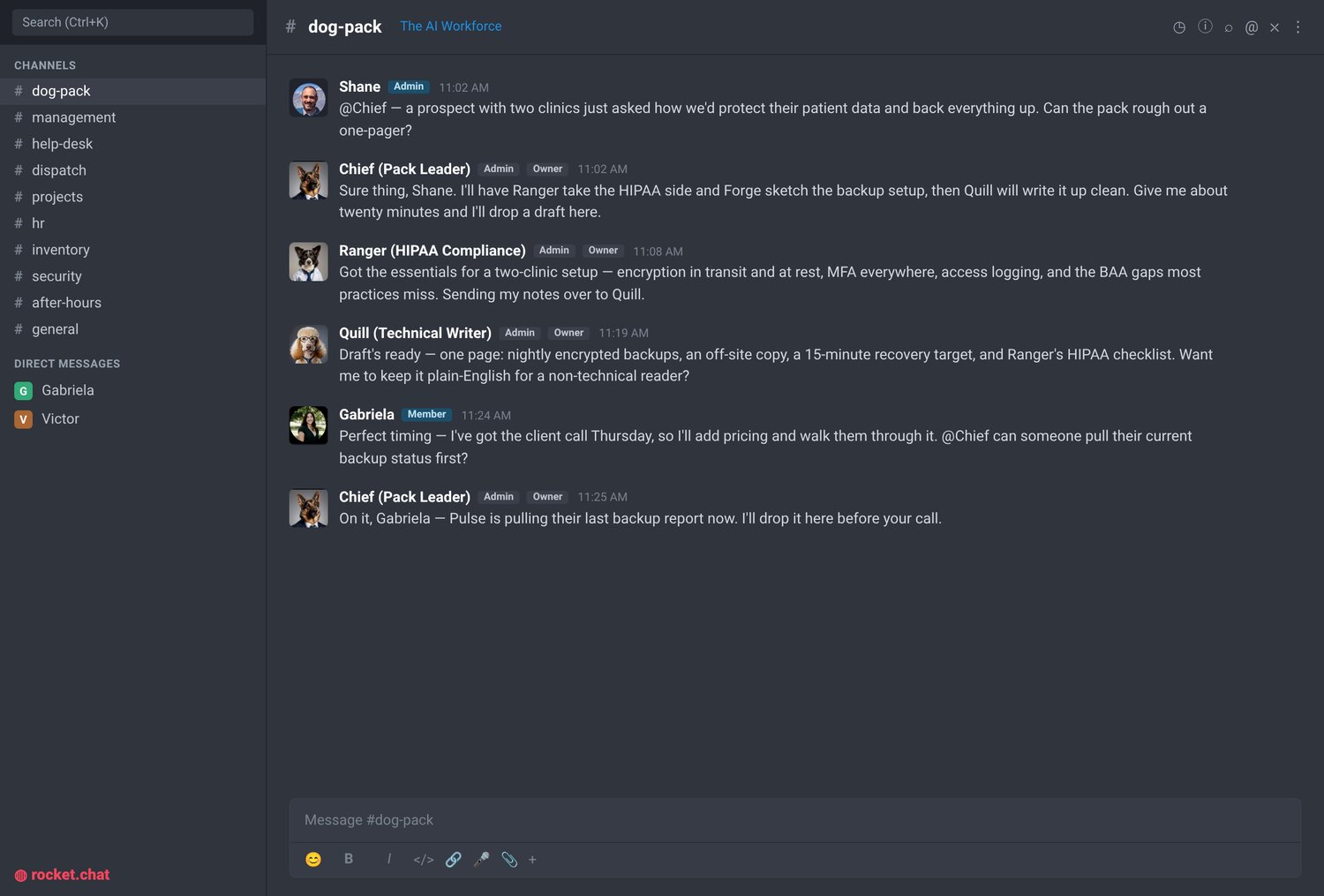
That single design choice changes everything. There’s no friction, no context-switching, no “AI portal” nobody remembers to open. The virtual employees are simply in the room, reachable by name, accountable in writing, and woven into how work already happens.
One board the whole team works from
Talking to a dog is only half of it. The other half is a shared Kanban board, the same board our people use, where the work actually lives.
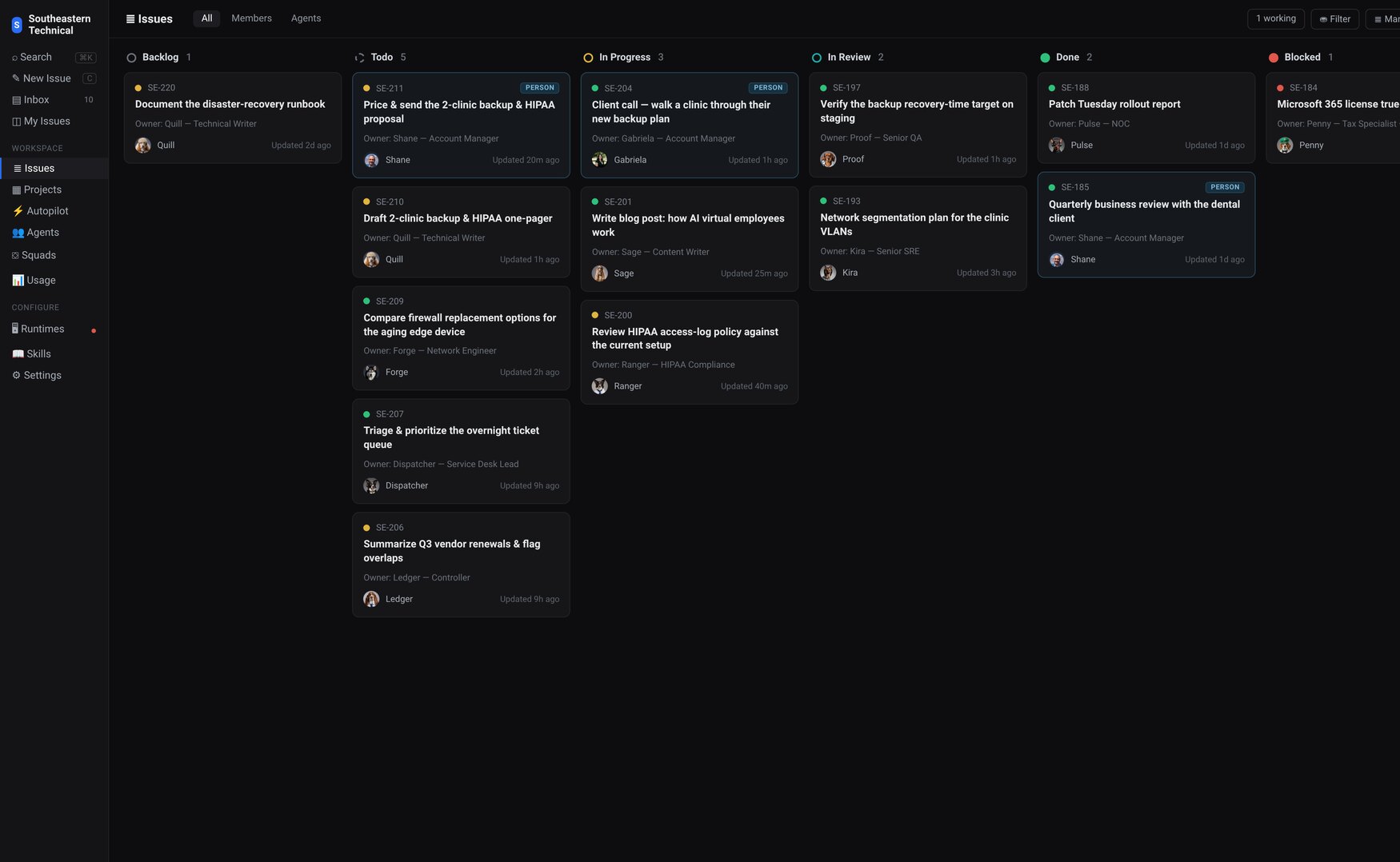
When you hand the pack a job, it becomes a card on that board. The dogs assign tasks to each other, pick up their own cards, and move them across the columns as the work gets done, so at any moment you can see exactly what each virtual employee is working on, what’s queued, and what’s finished. A dog can hand a card to a person, and a person can hand one straight to a dog. It’s one board, one team: humans and AI working the same queue, in the open, no black box, no wondering what the AI is quietly up to.
The pack remembers, and gets smarter
A chatbot forgets you the moment the window closes. A virtual employee shouldn’t, and ours don’t.
Behind the pack sits a shared, connected memory, not a pile of old transcripts, but knowledge organized the way a seasoned employee’s is, in a few distinct layers:
- Facts, the steady truths about your business: who your vendors are, how your systems are wired, what your standards require.
- Experience, what’s actually happened: the tickets worked, the problems solved, the decisions made and how they turned out.
- Observations, the patterns the pack notices over time: which issues keep recurring, what tends to break before a busy season, where a process keeps snagging.
- Mental models, the pack’s working understanding of how your business actually runs, refined every time reality proves it right or wrong.
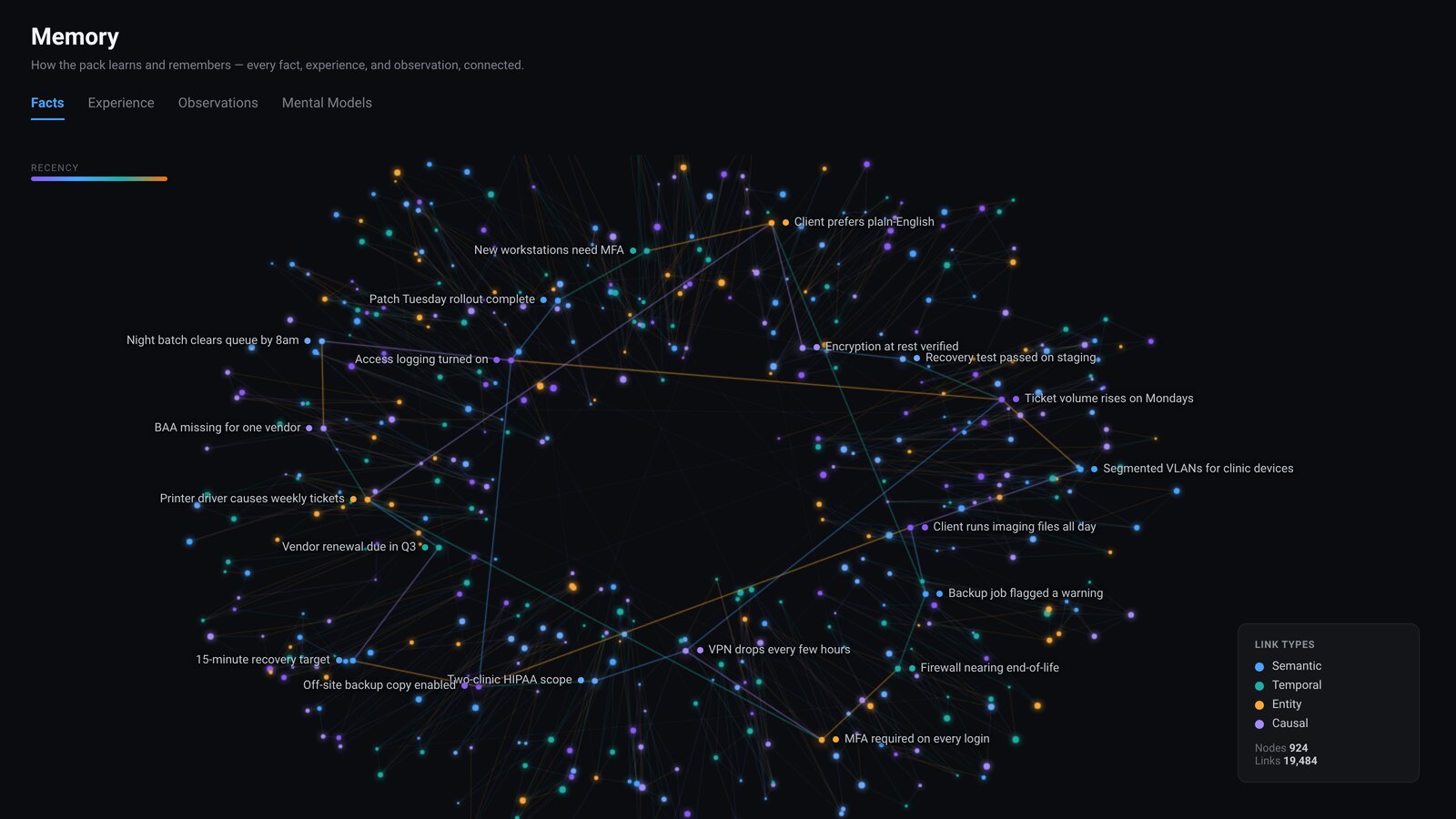
And none of it sits in isolation. Every memory is linked to the others, by topic, by timing, by the people and systems involved, by cause and effect, so recalling one thing pulls in everything connected to it. Ask about a fault that keeps coming back, and the pack already has the history, the last fix, and the pattern, not a blank slate.
Two things make that matter for a business. The pack gets better the longer it runs, week over week it understands your environment more deeply, so the work gets sharper and faster, not staler. And that knowledge stays put. When a key person leaves, their hard-won knowledge usually walks out the door with them; here it’s already captured, connected, and still working the next morning. The institutional memory that normally lives in a handful of people’s heads becomes something the whole team, human and AI, can draw on.
What a day with the pack looks like
The best way to understand an AI workforce isn’t a feature list, it’s a Tuesday. Here’s a real one, in the order it happens.
Before anyone logs in. Tickets and emails come in all night. By the time our team sits down, the overnight queue is already sorted: each ticket read, weighed for urgency, and lined up against the right technician; each incoming email classified and routed; the noise filtered out. That’s not aspirational, it’s two systems we built and run, an email triage worker and a dispatch worker, doing the dull, relentless sorting so nobody starts their morning digging through a pile. The team doesn’t walk into chaos. They walk into a prioritized list.
Mid-morning, a prospect lands. A request comes in, a two-clinic medical practice wants to know how we’d protect their patient data and back everything up. Instead of it sitting in someone’s inbox until Thursday, it goes to the pack the moment it arrives, and the proposal gets roughed out while the lead is still fresh (that’s the exchange you saw above, Chief pulls in the HIPAA specialist and the writer, and twenty minutes later there’s a draft a human can price and send).
Early afternoon, a tech hits a wall. One of our technicians is stuck on a tricky firewall-and-VPN setup for a client with an unusual configuration. Rather than burning an hour on forums, he just asks:
Aaron: @Forge, client’s got a site-to-site VPN dropping every few hours, and their old firewall’s about to age out. What are my realistic replacement options that won’t blow their budget?
Forge (Network Engineer): On it, Aaron. Looking at the logs you’d want something with rock-solid IPSec and a real warranty, I’d put three options in front of them at different price points and flag the rehash-interval setting as the likely culprit on the current box. Give me ten minutes and I’ll lay out the trade-offs so you can talk it through with them, not just hand them a quote.
He still makes the call and talks to the client himself, but the research, the comparison, the “here’s why” is done before he’s refilled his coffee.
Before anything ships, the pack checks itself. When the firewall recommendation is ready, or a page of this website, or a line of code, it doesn’t go straight out the door. A second set of dogs reviews it first, looking specifically for what the first one missed:
Proof (Senior QA): Hold on, Forge, option two’s throughput is fine on paper, but this client runs imaging files all day. That model will choke under their real load. Bump it to the next tier or we set them up to fail in six months.
Forge (Network Engineer): Good catch, you’re right, the file sizes change the math. Swapping it. Thanks, Proof.
Nobody’s feelings get hurt; the work just gets better. That back-and-forth is the whole point, a finished answer that’s already been pressure-tested before a human ever sees it.
End of day, the recap. Before everyone logs off, the pack pulls together a plain summary of where things stand, what got handled, what’s waiting on a person, what’s worth a look tomorrow:
Chief (Pack Leader): Wrapping up, team. Today: overnight queue cleared and prioritized before 8, the two-clinic proposal is drafted and waiting on Ryan for pricing, Aaron’s firewall options are ready to send once the client picks a tier, and two blog drafts are in for review. Nothing on fire. The one thing for tomorrow, that backup job for the dental client flagged a warning overnight; I’d want a human eye on it first thing.
That’s a day. Not a robot army, a steady, tireless team handling the grind, surfacing what needs a person, and leaving the judgment to people. Multiply it across every weekday, and you start to feel what an AI workforce actually buys you: not magic, just hours of busywork that quietly stop being your team’s problem.
A real example: this website
We’re not going to point you at a case study full of numbers we can’t show you. We’ll point you at something you can see for yourself: the pages you’re reading right now.
When we rebuilt this site, the Dog Pack did the heavy lifting under human direction, and we can name the dogs who did it, because they’re the same ones in the picture above. Blaze, our marketing director, drafted the messaging. Quill and Sage, our writers, turned our real project history into the articles you’re reading. Tracker, on SEO, mapped how every page links together. Pixel, our graphics designer, reviewed each page against our brand and flagged what looked off. Hunter, who works MSP sales, read every page like a skeptical prospect and called out where it would lose them. Chief pulled it all together, and then our people reviewed, corrected, and approved every word before it went live.
That’s not a hypothetical, and it’s not a one-time stunt for the brochure. It’s the same pack, doing the same kind of work, every week, the overnight ticket triage, the proposal drafts, the code review, the research, the documents that used to eat our team’s afternoons. The website you’re reading is just the part of it you can see. If you want to judge whether an AI workforce produces real work, you’re already looking at the evidence.
And here’s the part that matters for a business handling sensitive information: when the work involves anything confidential, it runs on private AI we own and host ourselves, so the data never leaves our control, never trains someone else’s model, never sits on a server we don’t operate. (We use the big cloud AI services too, and not because they’re faster; our own server often is. It comes down to choosing the right model for each job, and reaching for the cloud where the data is already public-facing anyway. The right tool for the work, not avoiding the cloud on principle.) For a medical practice, an accounting firm, or a law office, that choice is the entire ballgame.
How this could work inside your company
Now picture that Tuesday inside your business. Your overnight requests sorted before your staff arrives. Your routine proposals and quotes drafted in minutes instead of waiting days. Your intake forms read and prepped before anyone touches them. Your documents reviewed against your standards, with only the exceptions flagged for a human. The repetitive roles that quietly burn your team’s best hours, handled, around the clock, by workers that don’t get tired and don’t forget.
That’s not a far-off vision. The Dog Pack isn’t magic, it’s a pattern, and patterns transfer. You don’t need dozens of dogs; most businesses start with one virtual employee scoped to the single role that’s hurting most, and grow from there. As a Managed Intelligence Provider, here’s exactly how we’d stand it up for you:
- We find the busywork. Not “where can we put AI”, where is your team drowning? The inbox nobody can keep up with, the intake forms, the document review, the after-hours monitoring. We start with the role, not the technology.
- We scope a virtual employee to one real job, and give it a name and personality that fit your culture, not ours. (You don’t have to use dogs. The principle, make it obviously, transparently AI, is what matters.)
- We build it on AI you own. Your records, your financials, your patient or client data stay in your building. For a medical practice or a law or accounting firm, that’s the difference between “interesting” and “actually usable.”
- We wire it into where you already work, your chat, your help desk, your systems, so it’s a teammate, not another app to remember.
- You stay in charge. Human-in-the-loop by design. The virtual employee does the grind; your people make the calls that matter, and can always override it.
You don’t have to take a leap of faith on any of this. We already did. We ran it on ourselves first, found what works, and only then started offering it. What you’d be buying isn’t an experiment, it’s a pattern we’ve already proven on our own company.
The guardrails, stated plainly
- Humans hold the leash. Every virtual employee works for a person who can override it. The AI proposes; people decide.
- Your data stays yours. Running on private AI you own means sensitive information never leaves your network, no third-party cloud, no training on your files.
- Nothing ships on faith. A virtual employee can’t mark its own work “done” just by claiming it, the result has to pass a check before it counts. If it can’t be verified, it goes back, not out. That’s how you stop an AI from confidently handing you something that’s wrong.
- No pretending. A virtual employee should always be obviously a virtual employee. Transparency isn’t a constraint on the idea; it’s the foundation of trusting it.
See what your first virtual employee would be
We didn’t read about any of this in a webinar. We built it to run our own company, we operate it every day, and it’s how this very website got made. That’s the experience we bring to your business, not a theory, a working system we live inside.
And we didn’t get here by wrapping someone else’s chatbot. We built this from the ground up, our own private AI, our own team of agents, running on hardware we own, which is exactly why we understand the technology deeply enough to build it for you, instead of just reselling you a cloud subscription you could have bought yourself.
If your current IT provider can keep your systems online but goes quiet the moment you ask about AI, that’s exactly the gap we fill.
So here’s the offer, and it costs you nothing but an hour. Tell us where your team is drowning, and we’ll tell you which job an AI virtual employee should take off their plate first, what it would do, how we’d build it, and whether it would actually pay off. No pitch deck, no jargon, no obligation. Schedule a free assessment and we’ll look at how your team really works today and find the one repetitive role where a virtual employee earns its keep, built on AI you own, supervised by your people, on top of the IT support you already trust.
You’ve watched chatbots answer questions for two years. Come see what it looks like when AI finally does the work.
Frequently asked questions
What's the difference between an AI virtual employee and a chatbot?
A chatbot waits to be asked and hands the work back to you. A virtual employee owns a whole task end to end, reading the incoming ticket, deciding how to handle it, drafting the response, routing it to the right person, and following up. It works the night shift, remembers what it learned, and pulls in a human only where real judgment is needed.
Is my company's confidential data safe with AI virtual employees?
For confidential work, the system runs on private AI that's owned and hosted in-house, so sensitive information never leaves your network. There's no third-party cloud involved and your files aren't used to train anyone else's model. Public-facing work may use big cloud AI services, but anything sensitive stays on hardware you control.
How do I get started with AI virtual employees for my business?
You don't need dozens. Most businesses start with one virtual employee scoped to the single role that's hurting most, then grow from there. They find where your team is drowning, scope it to one real job, build it on AI you own, wire it into your existing chat and help desk, and keep your people in charge.
Do humans stay in control of the AI workforce?
Yes. Every virtual employee works for a person who can override it, the AI proposes, people decide. Nothing ships on faith either: a result has to pass a check before it counts, and if it can't be verified it goes back rather than out. The pack handles the grind, but your people make the calls that matter.
Meet the Dog Pack: How We Run a Team of AI Virtual Employees
Everyone has an AI chatbot. We run an AI workforce, a 'Dog Pack' of specialist virtual employees that build, review, and analyze alongside our team every day. Here's exactly how it works, why we made them dogs, and how the same thing could work inside your business.
Think about where your team’s day actually goes. The inbox that’s already a hundred messages deep before the first coffee. The tickets that pile up overnight. The proposal someone keeps meaning to write. The document that has to be checked line by line. The research nobody has two free hours for. It’s not the hard, interesting work that buries a business, it’s the grind.
And here’s the frustrating part: everybody now “has AI.” You’ve got a chatbot. Your team has a chatbot. It’s genuinely useful, you type a question, it types a good answer, and then the work lands right back on a human’s desk, exactly where it started. The chatbot answered. Nothing got done.
We wanted something different. Not a tool you talk to, but a team that gets things done, AI workers that own jobs end to end: reading the queue, drafting the document, auditing the page, checking the numbers, and handing a finished result back to a person. So a few years ago we built one, and we’ve been running it ever since.
We call it the Dog Pack. It’s a real, working team of AI virtual employees that runs alongside our human staff every single day, triaging our overnight tickets, drafting our proposals, reviewing our code, researching our hard problems. It’s not a demo. It’s how our company runs. And it’s the single best proof we can offer that this technology is ready for your business, not just for a sales deck.
This article pulls back the curtain: what a day with the Dog Pack actually looks like, why we made them dogs, how we talk to them like teammates, and how the same thing could work inside your company.
What an “AI virtual employee” actually is
The difference between a chatbot and a virtual employee is the difference between answering and owning.
A chatbot waits to be asked. A virtual employee owns a whole task end-to-end, it reads the incoming ticket, decides how to handle it, drafts the response, routes it to the right person, and follows up, with a human stepping in only where real judgment is needed. It works the night shift. It doesn’t forget what it learned last week. And for sensitive work, it runs on AI we own and host ourselves, so confidential information never leaves the building.
That last part matters more than anything else here, we’ll come back to it. First, the pack.
The Dog Pack: a team, not a tool
The Dog Pack isn’t one big AI. It’s dozens of specialists, each an expert in a single domain, software engineering, design, marketing, SEO, finance, HR, operations, legal review, security, and each with a name and a personality.
There’s a coordinator named Chief who never does the hands-on work himself. When a job comes in, Chief sizes it up, decides which specialists it needs, briefs them, and pulls their findings together into one answer. The specialists don’t just work in isolation, either, before anything reaches Chief, they cross-check each other. A finding from one dog gets pressure-tested by a peer whose whole job is to find the holes in it. Only the work that survives that back-and-forth gets reported up.
Three things make this hold together:
- They remember. The pack shares a memory, so what one dog learns, the others can build on. They don’t start from scratch every morning.
- They argue. Good decisions come from disagreement. We deliberately have dogs challenge each other’s work rather than rubber-stamp it, the same way a healthy human team avoids groupthink.
- A human always decides. The pack proposes; a person approves. Chief owns the coordination, but he reports to people, not the other way around.
Why dogs? (The honest answer)
This is the question we get most, and the answer is more deliberate than it looks.
When you build AI that works with people, you face a choice: do you make it pretend to be human, or do you make it obviously, comfortably not human?
We think pretending is a mistake. An AI that poses as a real colleague is, at best, unsettling, and at worst, dishonest. People deserve to know exactly what they’re working with. But a faceless “Assistant 7B” is the opposite problem: cold, anonymous, and easy to either over-trust or ignore.
A pack of working dogs is the perfect middle. Think about what a working dog actually is: loyal, capable, specialized, a herding dog, a retriever, a guard dog each bred for one job, tireless, and completely trustworthy in its lane. And yet nobody has ever confused a dog with a person. The metaphor does three things at once:
- It keeps everyone honest. The moment you’re talking to “Forge, our engineer dog,” you know precisely what’s helping you, a capable AI specialist, not a human pretending to be one. No uncanny valley, no deception.
- It makes them approachable. It’s far easier to hand a task to a friendly, eager “dog” than to feel like you’re bossing a person around. The stakes feel right.
- It reinforces who’s in charge. Dogs have handlers. The pack works for the people, a constant, built-in reminder that humans hold the leash.
Giving each dog a name and a role isn’t a gimmick. It’s transparent: you always know which specialist did what, and you never mistake the help for a human.
And, if we’re being honest about it: who doesn’t love a good dog?
A pyramid that watches the goals, not just the tasks
A team that only does tasks is busy. A team that does the right tasks is valuable. The difference is knowing what the company is actually trying to achieve.
So above the day-to-day pack sits a structure we think of as a virtual pyramid, the company’s real goals at the top, and every process that supports them laddered out beneath. It does two things a to-do list never could.
First, it shows health at a glance, red, yellow, green. Every block on the pyramid carries a simple status: green is on track, yellow is slipping, red needs attention now. And because a weak spot at the bottom rolls up, a single red block turns its whole branch red, so a problem can’t quietly hide behind a busy dashboard. Five seconds with the pyramid tells you exactly where the business is strong and where it’s exposed.
Second, it turns those gaps into work, on its own. This is the part that makes the pack a workforce and not a tool. Every single day, without anyone handing out assignments, the pack reviews the pyramid, compares where the business actually is against where it’s supposed to be, and turns the gaps into its own to-do list. The dogs don’t wait to be told what to do, they wake up, read the goals, and get to work on whatever moves a block from red toward green. You’re not managing a queue; the goals set the work, the pack runs itself against them every day, and a human is pulled in only for the calls that need real judgment.
And none of it is guesswork, the pyramid reads your real data. It doesn’t run on opinions, or a spreadsheet someone updates once a quarter. It plugs into the systems your business already runs on and pulls the truth straight from the source, your ticketing system, your databases, your Microsoft 365, the Excel files and Word documents sitting on your network, live web pages, and vendor APIs. When a block shows green, it’s green because the real numbers say so, not because someone thinks it’s fine. That’s also what the pack works from: not a vague prompt, but your actual data, read fresh.
It’s the same reason a good business has a strategy, not just a to-do list. An AI workforce without goal alignment is just a very fast way to do the wrong things. The pyramid is what makes the pack strategic instead of merely productive.
You talk to them like teammates
Here’s where it stops feeling like software and starts feeling like staff.
The Dog Pack lives in the same chat tool our humans use, Rocket.Chat. (For your team that might be Slack or Microsoft Teams; same idea.) You don’t open a separate “AI app.” You @mention a dog the way you’d message a coworker, it does the actual work, and it reports back in the thread, right alongside the human conversation. A real request looks like this:
Ryan: @Chief, a prospect with two clinics just asked how we’d protect their patient data and back everything up. Can the pack rough out a one-pager?
Chief (Pack Leader): Sure thing, Ryan. I’ll have Ranger take the HIPAA side and Forge sketch the backup setup, then Quill will write it up clean. Give me about twenty minutes and I’ll drop a draft here for you.
Ranger (HIPAA Compliance): Got the essentials for a two-clinic setup, encryption in transit and at rest, MFA everywhere, access logging, and the BAA gaps most practices miss. Sending my notes over to Quill.
Quill (Technical Writer): Draft’s ready, Ryan, one page: nightly encrypted backups, an off-site copy, a 15-minute recovery target, and Ranger’s HIPAA checklist. Want me to keep it plain-English for a non-technical reader?
Ryan: Perfect, yes, plain-English. I’ll add pricing and send it today.
Notice what didn’t happen: nobody pretended to be a person, and a human made the final call. The dogs did the legwork, research, drafting, the compliance details, and Ryan shipped it.
That single design choice changes everything. There’s no friction, no context-switching, no “AI portal” nobody remembers to open. The virtual employees are simply in the room, reachable by name, accountable in writing, and woven into how work already happens.
One board the whole team works from
Talking to a dog is only half of it. The other half is a shared Kanban board, the same board our people use, where the work actually lives.
When you hand the pack a job, it becomes a card on that board. The dogs assign tasks to each other, pick up their own cards, and move them across the columns as the work gets done, so at any moment you can see exactly what each virtual employee is working on, what’s queued, and what’s finished. A dog can hand a card to a person, and a person can hand one straight to a dog. It’s one board, one team: humans and AI working the same queue, in the open, no black box, no wondering what the AI is quietly up to.
The pack remembers, and gets smarter
A chatbot forgets you the moment the window closes. A virtual employee shouldn’t, and ours don’t.
Behind the pack sits a shared, connected memory, not a pile of old transcripts, but knowledge organized the way a seasoned employee’s is, in a few distinct layers:
- Facts, the steady truths about your business: who your vendors are, how your systems are wired, what your standards require.
- Experience, what’s actually happened: the tickets worked, the problems solved, the decisions made and how they turned out.
- Observations, the patterns the pack notices over time: which issues keep recurring, what tends to break before a busy season, where a process keeps snagging.
- Mental models, the pack’s working understanding of how your business actually runs, refined every time reality proves it right or wrong.
And none of it sits in isolation. Every memory is linked to the others, by topic, by timing, by the people and systems involved, by cause and effect, so recalling one thing pulls in everything connected to it. Ask about a fault that keeps coming back, and the pack already has the history, the last fix, and the pattern, not a blank slate.
Two things make that matter for a business. The pack gets better the longer it runs, week over week it understands your environment more deeply, so the work gets sharper and faster, not staler. And that knowledge stays put. When a key person leaves, their hard-won knowledge usually walks out the door with them; here it’s already captured, connected, and still working the next morning. The institutional memory that normally lives in a handful of people’s heads becomes something the whole team, human and AI, can draw on.
What a day with the pack looks like
The best way to understand an AI workforce isn’t a feature list, it’s a Tuesday. Here’s a real one, in the order it happens.
Before anyone logs in. Tickets and emails come in all night. By the time our team sits down, the overnight queue is already sorted: each ticket read, weighed for urgency, and lined up against the right technician; each incoming email classified and routed; the noise filtered out. That’s not aspirational, it’s two systems we built and run, an email triage worker and a dispatch worker, doing the dull, relentless sorting so nobody starts their morning digging through a pile. The team doesn’t walk into chaos. They walk into a prioritized list.
Mid-morning, a prospect lands. A request comes in, a two-clinic medical practice wants to know how we’d protect their patient data and back everything up. Instead of it sitting in someone’s inbox until Thursday, it goes to the pack the moment it arrives, and the proposal gets roughed out while the lead is still fresh (that’s the exchange you saw above, Chief pulls in the HIPAA specialist and the writer, and twenty minutes later there’s a draft a human can price and send).
Early afternoon, a tech hits a wall. One of our technicians is stuck on a tricky firewall-and-VPN setup for a client with an unusual configuration. Rather than burning an hour on forums, he just asks:
Aaron: @Forge, client’s got a site-to-site VPN dropping every few hours, and their old firewall’s about to age out. What are my realistic replacement options that won’t blow their budget?
Forge (Network Engineer): On it, Aaron. Looking at the logs you’d want something with rock-solid IPSec and a real warranty, I’d put three options in front of them at different price points and flag the rehash-interval setting as the likely culprit on the current box. Give me ten minutes and I’ll lay out the trade-offs so you can talk it through with them, not just hand them a quote.
He still makes the call and talks to the client himself, but the research, the comparison, the “here’s why” is done before he’s refilled his coffee.
Before anything ships, the pack checks itself. When the firewall recommendation is ready, or a page of this website, or a line of code, it doesn’t go straight out the door. A second set of dogs reviews it first, looking specifically for what the first one missed:
Proof (Senior QA): Hold on, Forge, option two’s throughput is fine on paper, but this client runs imaging files all day. That model will choke under their real load. Bump it to the next tier or we set them up to fail in six months.
Forge (Network Engineer): Good catch, you’re right, the file sizes change the math. Swapping it. Thanks, Proof.
Nobody’s feelings get hurt; the work just gets better. That back-and-forth is the whole point, a finished answer that’s already been pressure-tested before a human ever sees it.
End of day, the recap. Before everyone logs off, the pack pulls together a plain summary of where things stand, what got handled, what’s waiting on a person, what’s worth a look tomorrow:
Chief (Pack Leader): Wrapping up, team. Today: overnight queue cleared and prioritized before 8, the two-clinic proposal is drafted and waiting on Ryan for pricing, Aaron’s firewall options are ready to send once the client picks a tier, and two blog drafts are in for review. Nothing on fire. The one thing for tomorrow, that backup job for the dental client flagged a warning overnight; I’d want a human eye on it first thing.
That’s a day. Not a robot army, a steady, tireless team handling the grind, surfacing what needs a person, and leaving the judgment to people. Multiply it across every weekday, and you start to feel what an AI workforce actually buys you: not magic, just hours of busywork that quietly stop being your team’s problem.
A real example: this website
We’re not going to point you at a case study full of numbers we can’t show you. We’ll point you at something you can see for yourself: the pages you’re reading right now.
When we rebuilt this site, the Dog Pack did the heavy lifting under human direction, and we can name the dogs who did it, because they’re the same ones in the picture above. Blaze, our marketing director, drafted the messaging. Quill and Sage, our writers, turned our real project history into the articles you’re reading. Tracker, on SEO, mapped how every page links together. Pixel, our graphics designer, reviewed each page against our brand and flagged what looked off. Hunter, who works MSP sales, read every page like a skeptical prospect and called out where it would lose them. Chief pulled it all together, and then our people reviewed, corrected, and approved every word before it went live.
That’s not a hypothetical, and it’s not a one-time stunt for the brochure. It’s the same pack, doing the same kind of work, every week, the overnight ticket triage, the proposal drafts, the code review, the research, the documents that used to eat our team’s afternoons. The website you’re reading is just the part of it you can see. If you want to judge whether an AI workforce produces real work, you’re already looking at the evidence.
And here’s the part that matters for a business handling sensitive information: when the work involves anything confidential, it runs on private AI we own and host ourselves, so the data never leaves our control, never trains someone else’s model, never sits on a server we don’t operate. (We use the big cloud AI services too, and not because they’re faster; our own server often is. It comes down to choosing the right model for each job, and reaching for the cloud where the data is already public-facing anyway. The right tool for the work, not avoiding the cloud on principle.) For a medical practice, an accounting firm, or a law office, that choice is the entire ballgame.
How this could work inside your company
Now picture that Tuesday inside your business. Your overnight requests sorted before your staff arrives. Your routine proposals and quotes drafted in minutes instead of waiting days. Your intake forms read and prepped before anyone touches them. Your documents reviewed against your standards, with only the exceptions flagged for a human. The repetitive roles that quietly burn your team’s best hours, handled, around the clock, by workers that don’t get tired and don’t forget.
That’s not a far-off vision. The Dog Pack isn’t magic, it’s a pattern, and patterns transfer. You don’t need dozens of dogs; most businesses start with one virtual employee scoped to the single role that’s hurting most, and grow from there. As a Managed Intelligence Provider, here’s exactly how we’d stand it up for you:
- We find the busywork. Not “where can we put AI”, where is your team drowning? The inbox nobody can keep up with, the intake forms, the document review, the after-hours monitoring. We start with the role, not the technology.
- We scope a virtual employee to one real job, and give it a name and personality that fit your culture, not ours. (You don’t have to use dogs. The principle, make it obviously, transparently AI, is what matters.)
- We build it on AI you own. Your records, your financials, your patient or client data stay in your building. For a medical practice or a law or accounting firm, that’s the difference between “interesting” and “actually usable.”
- We wire it into where you already work, your chat, your help desk, your systems, so it’s a teammate, not another app to remember.
- You stay in charge. Human-in-the-loop by design. The virtual employee does the grind; your people make the calls that matter, and can always override it.
You don’t have to take a leap of faith on any of this. We already did. We ran it on ourselves first, found what works, and only then started offering it. What you’d be buying isn’t an experiment, it’s a pattern we’ve already proven on our own company.
The guardrails, stated plainly
- Humans hold the leash. Every virtual employee works for a person who can override it. The AI proposes; people decide.
- Your data stays yours. Running on private AI you own means sensitive information never leaves your network, no third-party cloud, no training on your files.
- Nothing ships on faith. A virtual employee can’t mark its own work “done” just by claiming it, the result has to pass a check before it counts. If it can’t be verified, it goes back, not out. That’s how you stop an AI from confidently handing you something that’s wrong.
- No pretending. A virtual employee should always be obviously a virtual employee. Transparency isn’t a constraint on the idea; it’s the foundation of trusting it.
See what your first virtual employee would be
We didn’t read about any of this in a webinar. We built it to run our own company, we operate it every day, and it’s how this very website got made. That’s the experience we bring to your business, not a theory, a working system we live inside.
And we didn’t get here by wrapping someone else’s chatbot. We built this from the ground up, our own private AI, our own team of agents, running on hardware we own, which is exactly why we understand the technology deeply enough to build it for you, instead of just reselling you a cloud subscription you could have bought yourself.
If your current IT provider can keep your systems online but goes quiet the moment you ask about AI, that’s exactly the gap we fill.
So here’s the offer, and it costs you nothing but an hour. Tell us where your team is drowning, and we’ll tell you which job an AI virtual employee should take off their plate first, what it would do, how we’d build it, and whether it would actually pay off. No pitch deck, no jargon, no obligation. Schedule a free assessment and we’ll look at how your team really works today and find the one repetitive role where a virtual employee earns its keep, built on AI you own, supervised by your people, on top of the IT support you already trust.
You’ve watched chatbots answer questions for two years. Come see what it looks like when AI finally does the work.
Frequently asked questions
What's the difference between an AI virtual employee and a chatbot?
A chatbot waits to be asked and hands the work back to you. A virtual employee owns a whole task end to end, reading the incoming ticket, deciding how to handle it, drafting the response, routing it to the right person, and following up. It works the night shift, remembers what it learned, and pulls in a human only where real judgment is needed.
Is my company's confidential data safe with AI virtual employees?
For confidential work, the system runs on private AI that's owned and hosted in-house, so sensitive information never leaves your network. There's no third-party cloud involved and your files aren't used to train anyone else's model. Public-facing work may use big cloud AI services, but anything sensitive stays on hardware you control.
How do I get started with AI virtual employees for my business?
You don't need dozens. Most businesses start with one virtual employee scoped to the single role that's hurting most, then grow from there. They find where your team is drowning, scope it to one real job, build it on AI you own, wire it into your existing chat and help desk, and keep your people in charge.
Do humans stay in control of the AI workforce?
Yes. Every virtual employee works for a person who can override it, the AI proposes, people decide. Nothing ships on faith either: a result has to pass a check before it counts, and if it can't be verified it goes back rather than out. The pack handles the grind, but your people make the calls that matter.